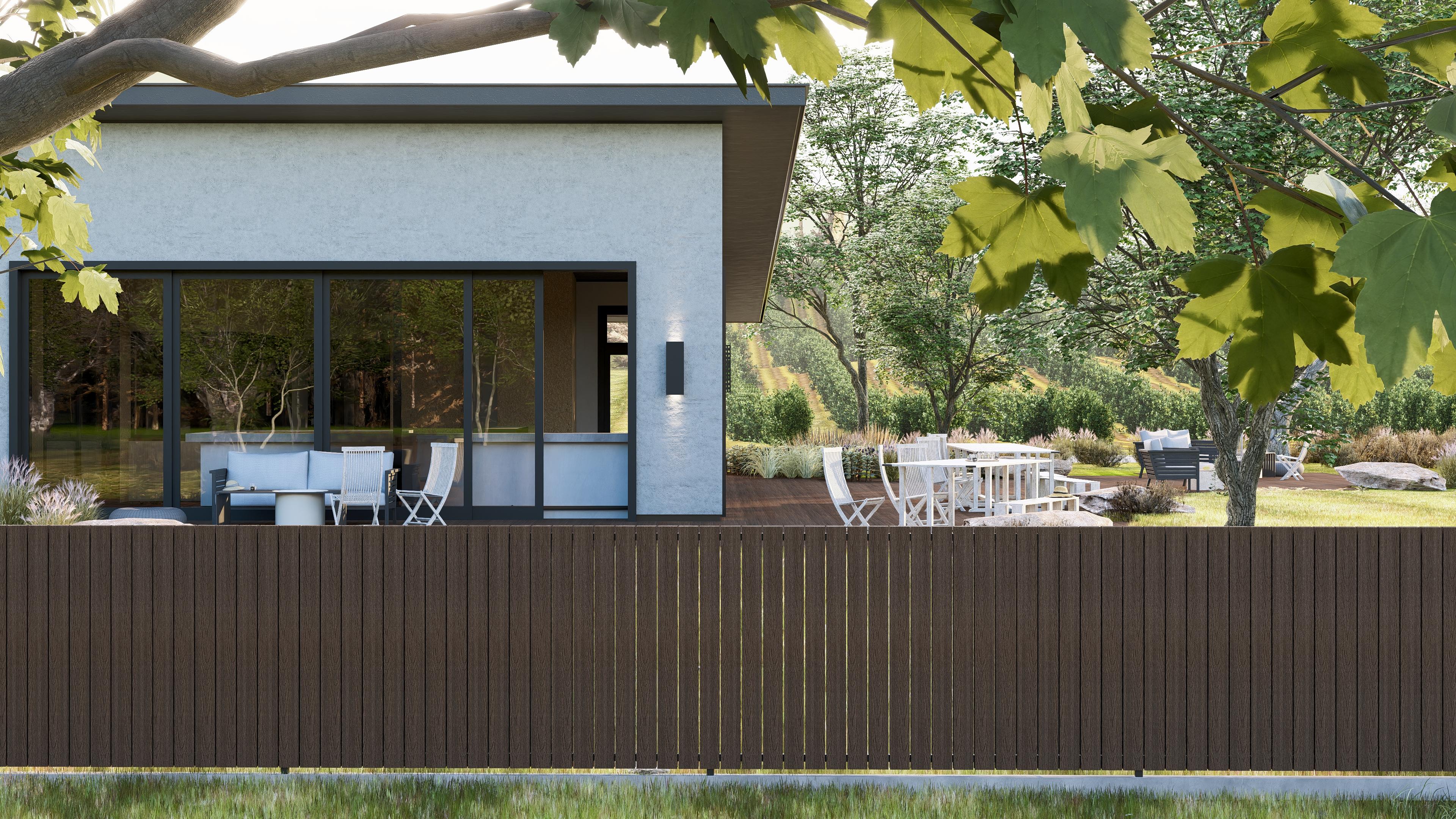
Fence boards and low-maintenance composite fencing
Timbermax fence boards are designed for contemporary garden fencing, gates and infill panels where a wood appearance is desired without regular repainting. Composite fencing is planned as a complete system with a suitable supporting structure and controlled spacing. Although customers often search for a “maintenance-free fence”, low-maintenance fencing is the technically accurate description because routine cleaning is still required.
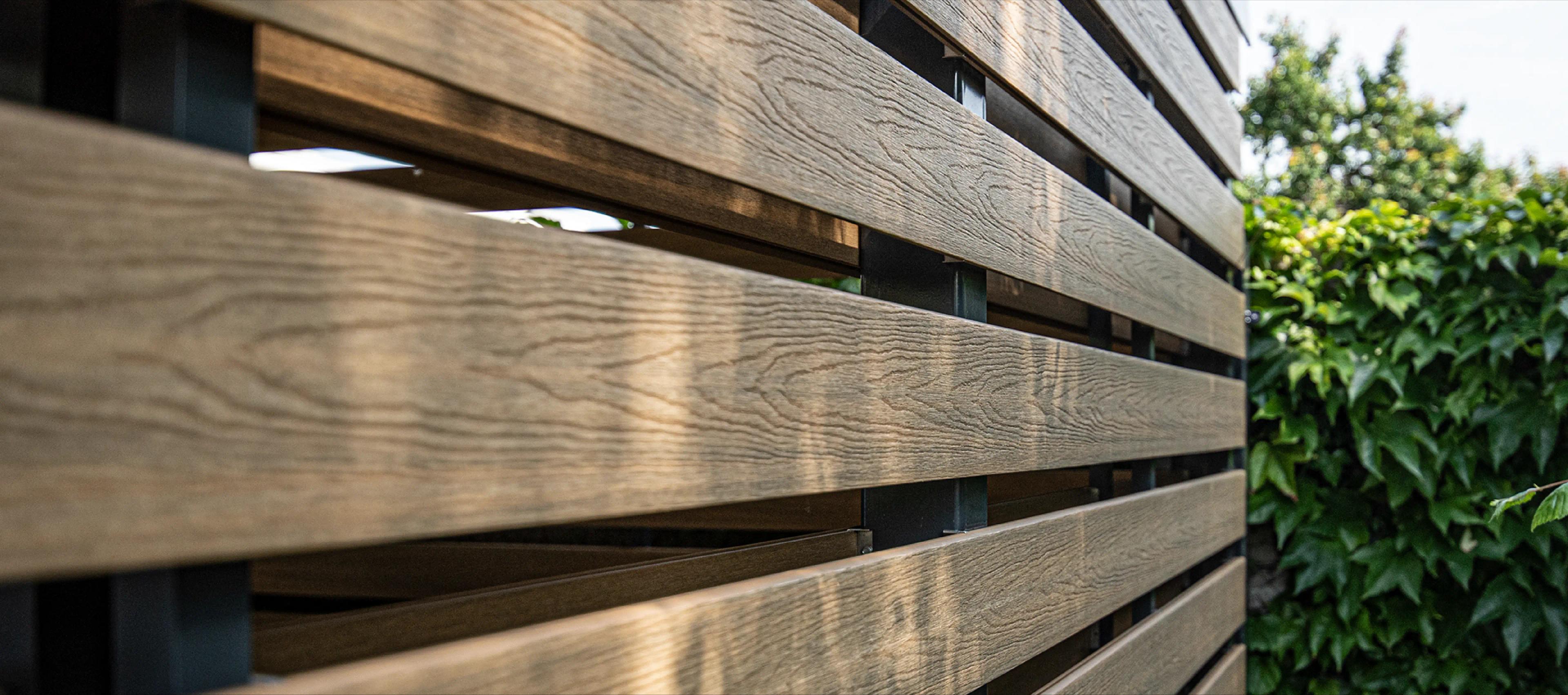
A fence can provide full privacy or a more open appearance depending on the architecture and site. We consider profile orientation, board spacing, posts, anchoring and wind load as part of the design.
Composite fence boards can also be used for gates and pedestrian-gate infill, helping maintain a consistent material and colour concept across the entrance and surrounding exterior.
Timbermax fence projects include solid and open infill layouts, different profiles and shades, and combinations with metal supporting structures.
Common questions about WPC fences
With a WPC fence, the infill is only part of the system. Supporting structure, spacing, expansion allowance and correct anchoring are equally important.
What is a WPC fence?
A WPC fence uses composite profiles as infill between posts or within a frame. The material combines a wood-based component with polymer and is intended for long-term exterior use without the regular oiling or painting associated with timber.
Does a WPC fence require maintenance?
WPC infill does not require regular coatings or oiling. Routine care mainly consists of washing the surface and removing dirt. Correct structural design of posts, frames and anchors is equally important for long-term performance.
Can a WPC fence provide full privacy?
Yes. Depending on profile selection and spacing, the infill can be made more solid or more open. Wind load, fence height and anchoring must also be considered because a solid privacy screen transfers higher loads to the supporting structure.
WPC fence or timber fence?
Timber has a natural appearance but usually needs recurring coatings or oiling to preserve its finish. WPC is suited to projects where a stable appearance and lower surface-maintenance requirements are priorities.
No-obligation quote
Planning a Timbermax fence?
Send us the basic project details and we will get back to you with the next steps.
Further information
Thanks to their distinctive appearance, documented technical parameters and low-maintenance surface, Timbermax composite boards are a suitable material for use in the construction industry in places where wood is too difficult to maintain and unprofitable as a suitable investment in the long term.
Construction for Timbermax fences.
Most contractors use wood or wood-plastic substructure materials in the manufacture of fences due to cost and ease of installation. Based on our many years of experience, we can say with certainty that aluminium is the ideal material for fence substructure. This material is highly resistant and durable with an excellent weight to strength ratio. Aluminium profiles are perfectly straight and hold screws perfectly. A solid and balanced substructure is a prerequisite for assembling a perfectly long-lasting fence.
As with the foundation of the house, there is no need to skimp on the supporting element of the fence. From our point of view, it is counterproductive to invest money in a substructure with less durability than the fence cladding itself. A fence with a poor quality substructure is cheaper only at first glance.
Substructures made of wood lose their strength after a few years during the constant accumulation of moisture and frost, do not hold screws, become moldy and gradually disintegrate. This is also true for waterlogged timber. For a wood subfloor to last for many years, it would need to be treated annually as a fence surface material. In the photos you can see one of the many timber structures we dismantled for a client and then replaced with our aluminium structure.
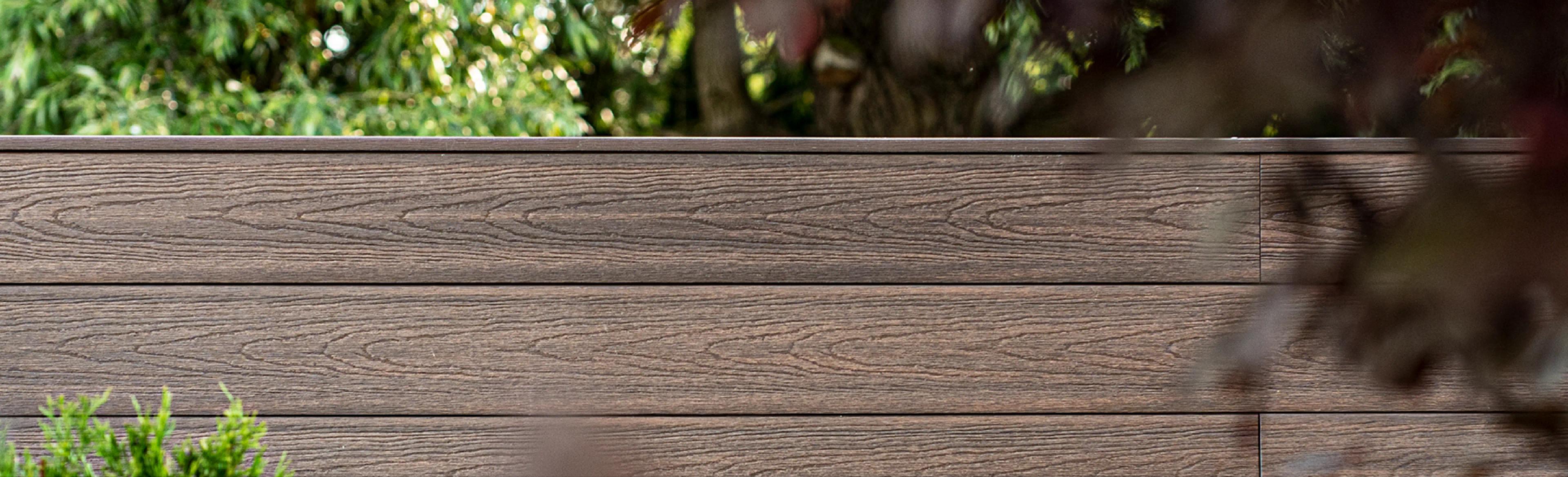
Thanks to in-house developed components, the installation of our fences is fast, practical and long-lasting. Each component is designed to fit together precisely, allowing for seamless assembly without the need for complex adjustments or special tools. This system saves time and effort during installation, greatly speeding up the entire process.
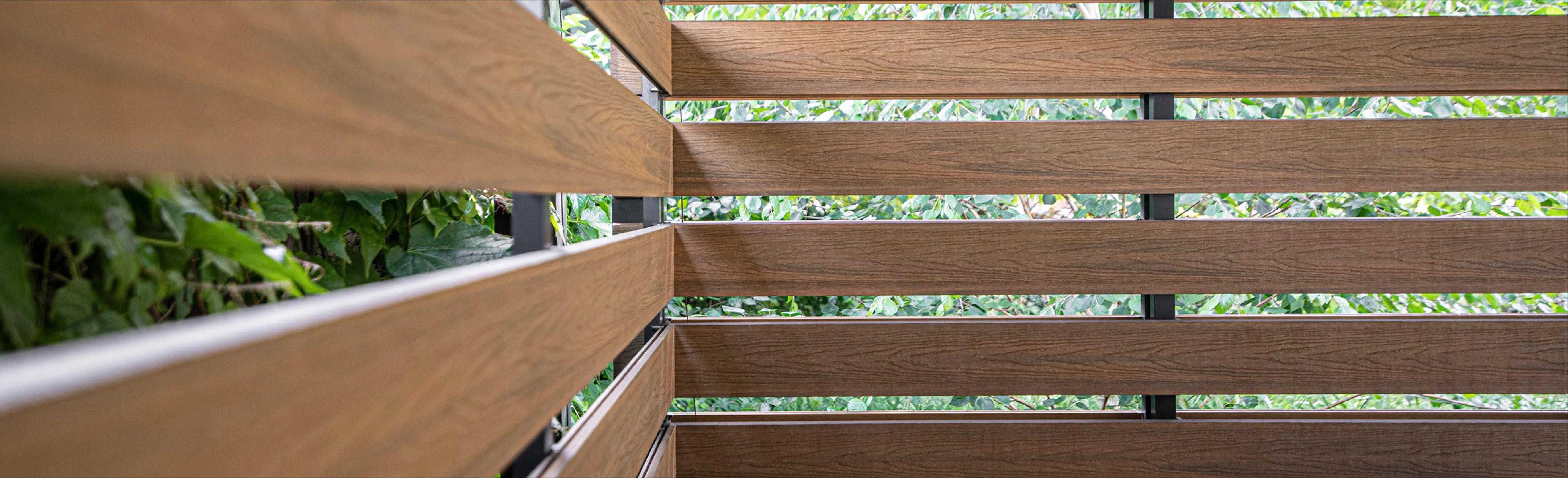
Fence mounting options according to the substrate:
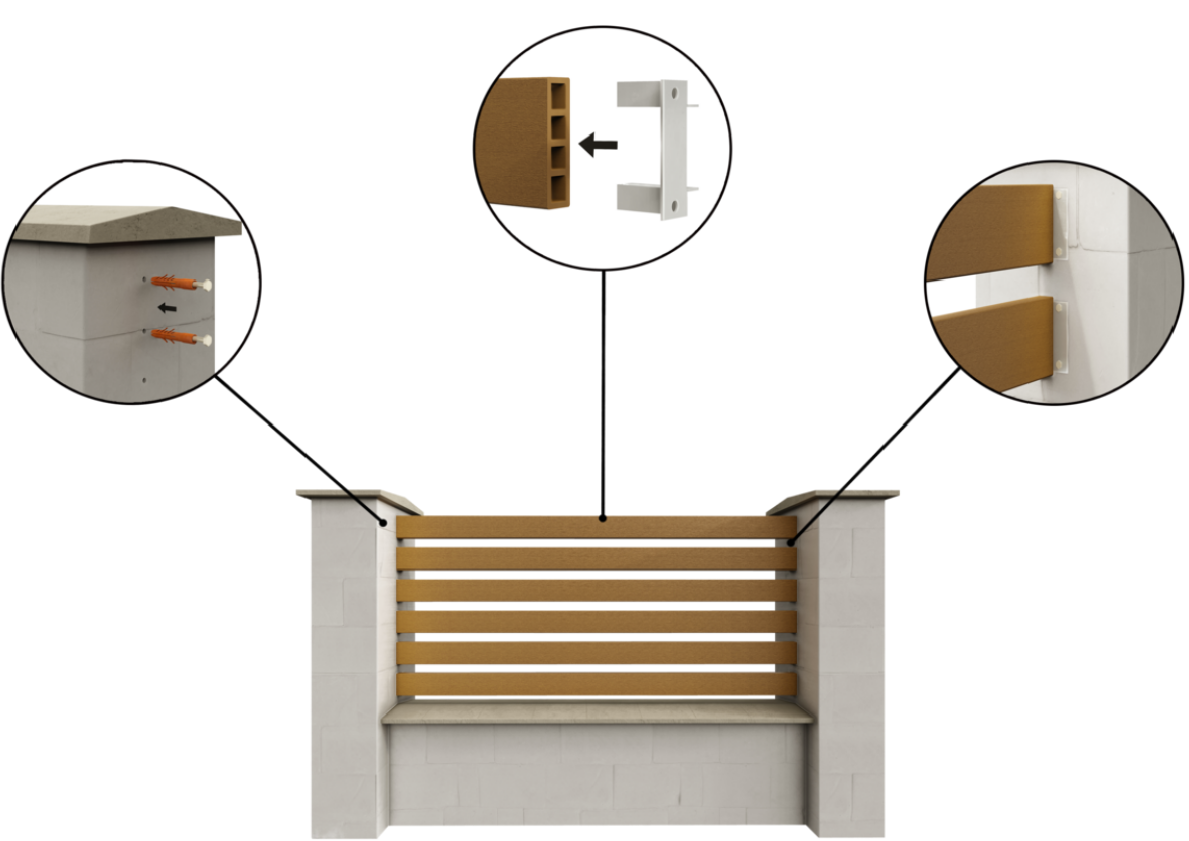
Used profile P107, dimension 107 x 30 mm, lengths 2900 and 4200 mm. The gap is optional. Anchoring method: steel bracket KP107 inserted into the ends of the P107 profiles and bolted against the column.
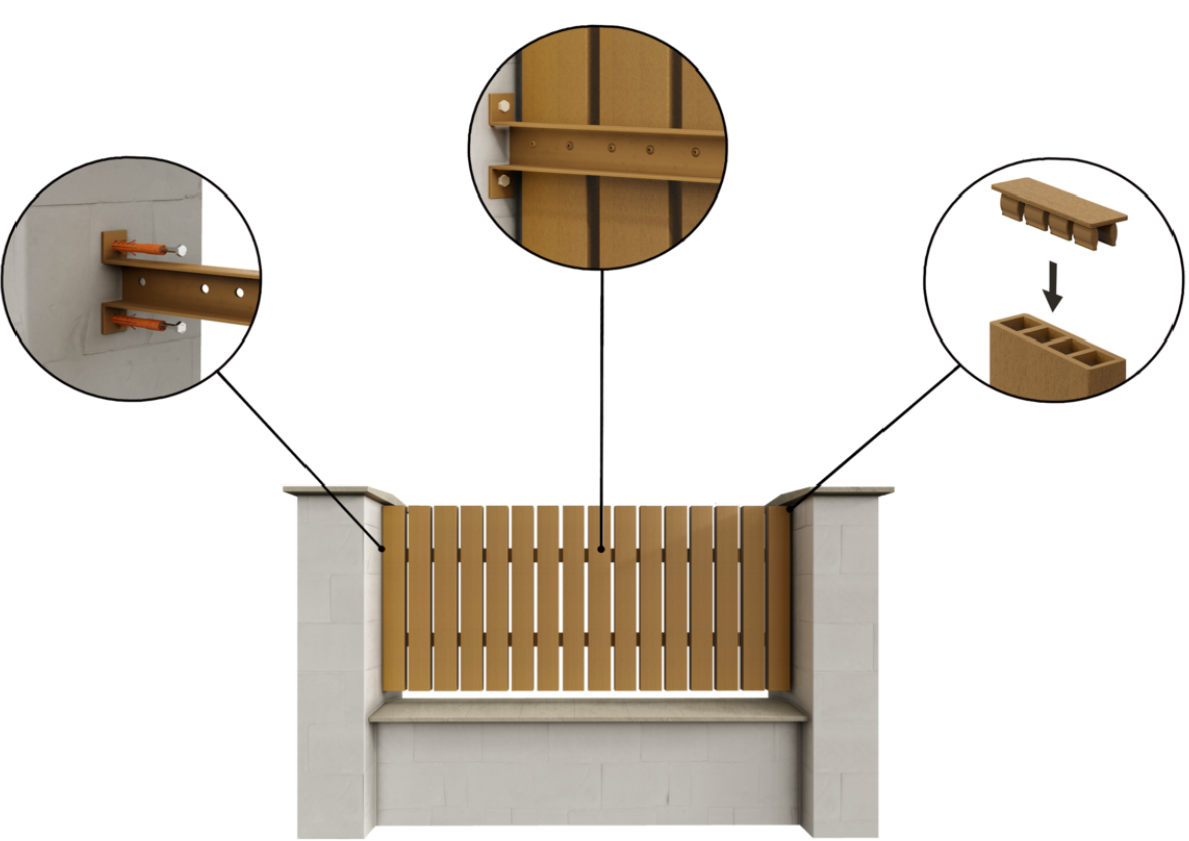
Profiles P107 screwed as a classic wooden fence on a metal support profile. It is possible to supply the headed screws in the RAL colour of the supporting metal profile. Termination of the upper edges by inserting the KP107 cap.
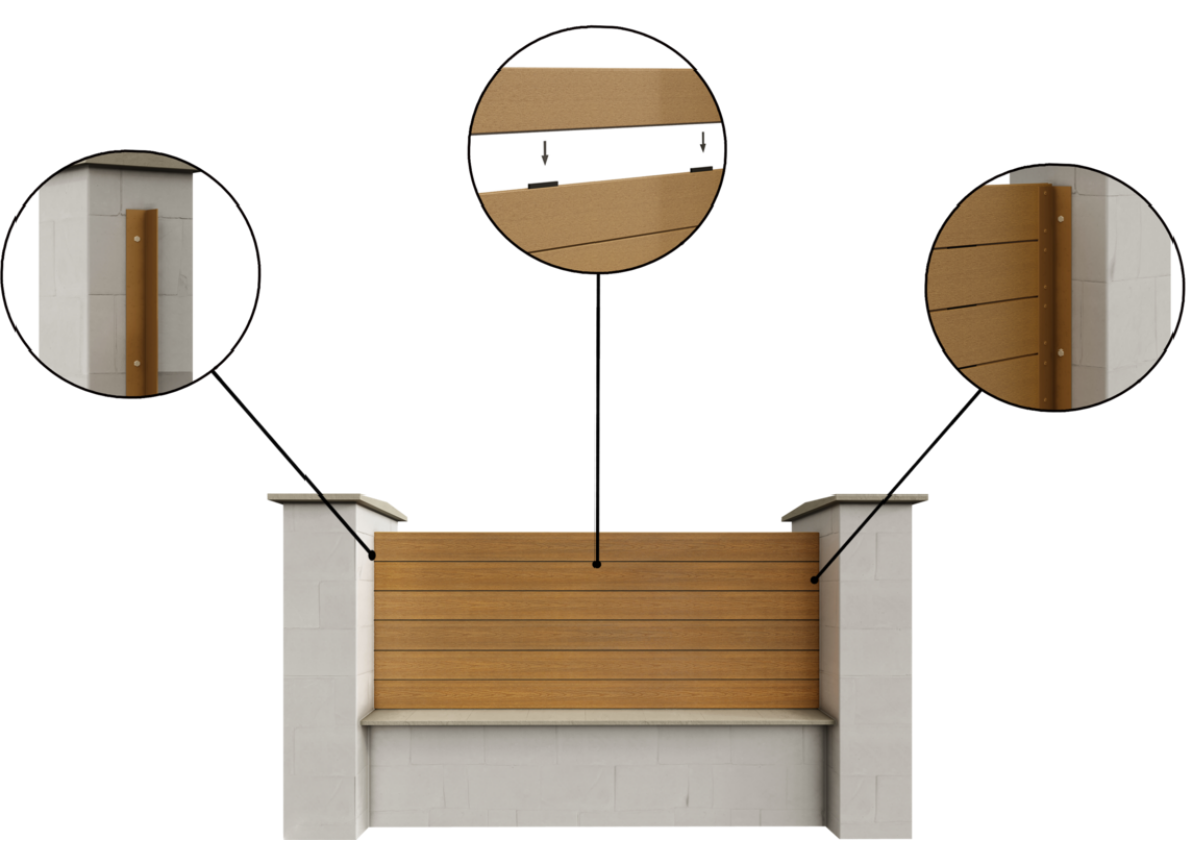
T138 profiles screwed on the ends from the back side against the metal L profile. Boundary washers prevent individual movement of the plates in the transverse direction.
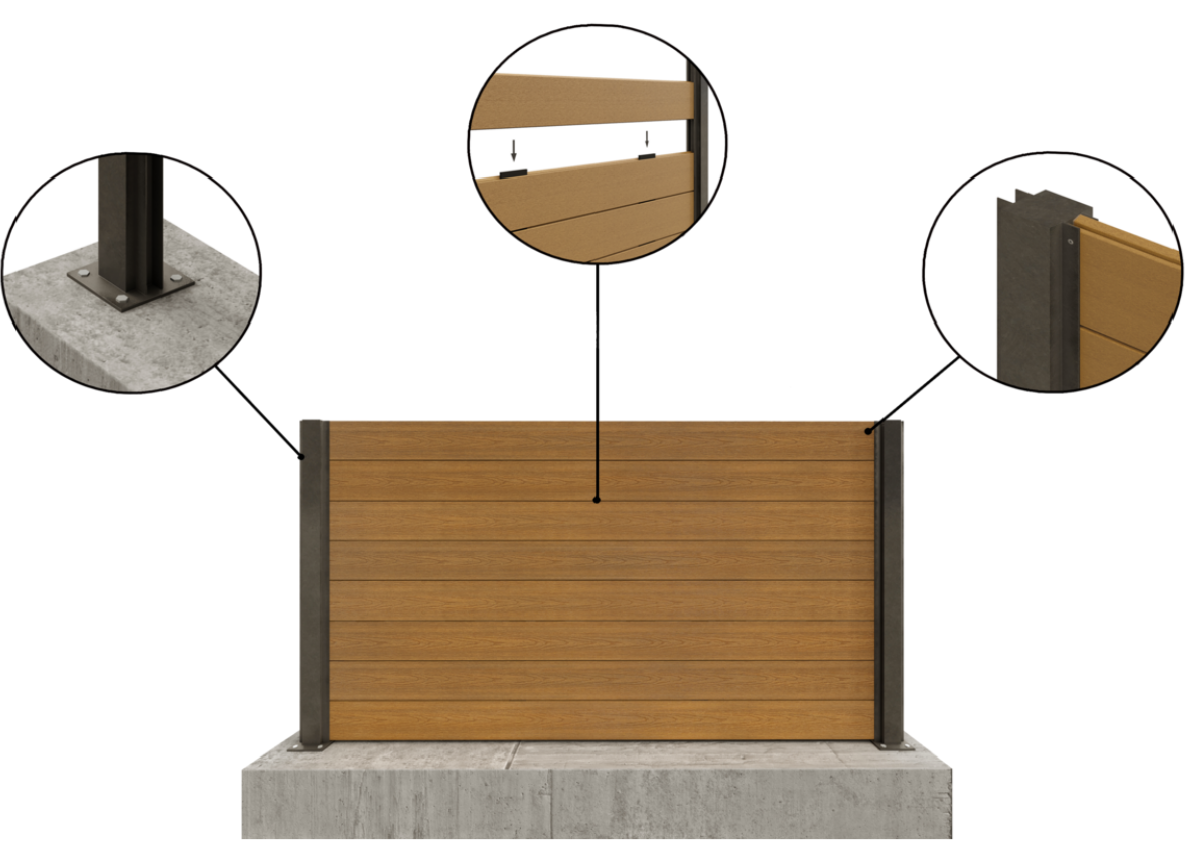
The fence is designed using metal poles. They can be made of iron with galvanizing or stainless steel with RAL colour finish. In this case, the T138 profiles are inserted into the U-profiles. The last plate is finished with a bolt through the U profile.